Search
Sensors

Self-Calibrating Virtual Sensor
The virtual air data sensor leverages smartphone-grade inertial and GPS sensors with advanced computational methods to generate accurate air flow data in real time. The innovation uses inexpensive sensors typically present on smartphones, along with real-time modeling, filtering, and data reconstruction using kinematic equations. Operating within the aircraft fuselage, the algorithm avoids environmental exposure and flow field complications affecting traditional external sensors.
The algorithm employs a dual-methodology approach for real-time air flow estimation. It calibrates an aerodynamic model during calm air conditions, using aircraft response characteristics to compute air flow angles from vertical and lateral acceleration data through frequency-domain modeling. Simultaneously, kinematic relationships with GPS-corrected sensor bias estimation reconstruct independent air flow data at lower update rates. Advanced complementary filtering blends these streams to generate continuous airspeed, angle of attack, and sideslip angle measurements. The algorithm incorporates automated calibration, vertical acceleration-based alpha estimation, and GPS-based low-frequency angle reconstruction using kinematic expressions.
The innovative algorithm is self-calibrating and provides independent, reliable, and accurate virtual sensing that can be implemented with readily-available hardware. The technology is currently TRL 5 (component validated in relevant environment) and available for licensing.
instrumentation
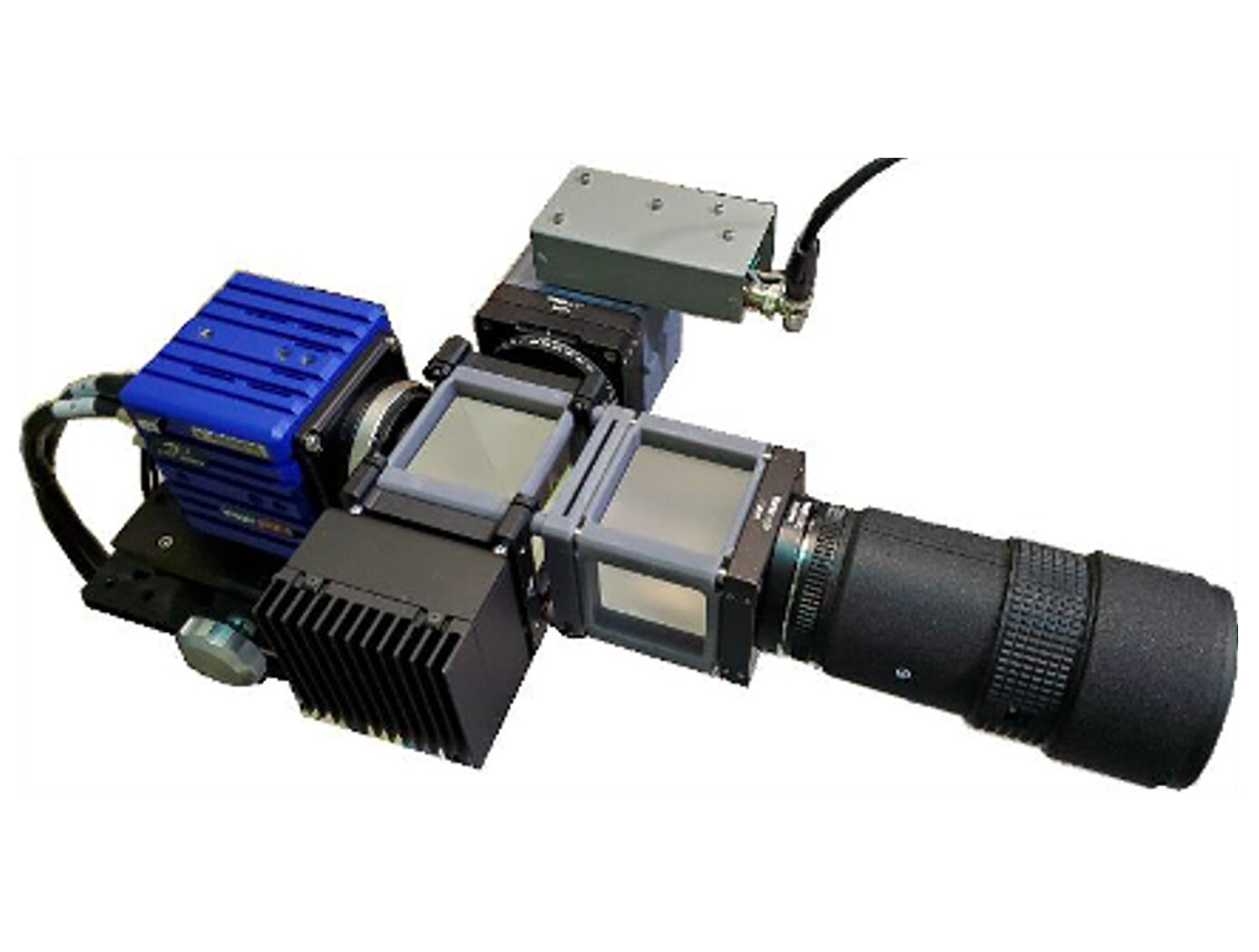
Assembly for Simplified Hi-Res Flow Visualization
NASAs single grid, self-aligned focusing schlieren optical assembly is attached to a commercial-off-the-shelf camera. It directs light from the light source through a condenser lens and linear polarizer towards a polarizing beam-splitter where the linear, vertically-polarized component of light is reflected onto the optical axis of the instrument. The light passes through a Ronchi ruling grid, a polarizing prism, and a quarter-wave plate prior to projection from the assembly as right-circularly polarized light. The grid-patterned light (having passed through the Ronchi grid) is directed past the density object onto a retroreflective background that serves as the source grid. Upon reflection off the retroreflective background, the polarization state of light is mirrored. It passes the density object a second time and is then reimaged by the system. Upon encountering the polarizing prism the second time, the light is refracted resulting in a slight offset. This refracted light passes through the Ronchi ruling grid, now serving as the cutoff grid, for a second time before being imaged by the camera.
Both small- and large-scale experimental set ups have been evaluated and shown to be capable of fields-of-view of 10 and 300 millimeters respectively. Observed depths of field were found to be comparable to existing systems. Light sources, polarizing prisms, retroreflective materials and lenses can be customized to suit a particular experiment. For example, with a high speed camera and laser light source, the system has collected flow images at a rate of 1MHz.